Remedial classes help children to strengthen their academic foundation. Many children struggle to keep up with their grade-level learning in their education. Each child has their own capability to learn and understand. Some children are weak in understanding and learning. Due to their weakness, slow learner and learning gaps they have to face difficulties to keep up their grade. These issues affect a child's confidence, performance and long term academic success. To overcome this problems SShrishti providing Remedial and bridge education programs to all over India.
In navigating from primary to secondary and higher education some time should be challenging; If the foundation education is not clear.
Sshrishti understands the Key transformation in learning dynamics, moving from foundational skills to advanced proficiency. This transition phase can be particularly challenging for students who are slow learners.
Sshrishti remedial education program is designed to provide crucial support to those who may be lagging behind in their studies. This targeted initiative is especially important for students from low-income backgrounds, slow learners who often encounter early challenges in their educational journey.
Remedial Classes are designed for slow learners. In this method, we provide extra classes for slow learners to support them. Where they learn on their weak topics and focus on improving it. Our trained Teachers focus on identifying weak areas and overcoming their learning difficulties. Where we not only work on strengthening basic concepts but also provide personalized learning
The main goal of remedial education is to bring students up to the expected learning level by strengthening their core skills. It includes personalized attention, simplified teaching methods, and regular practice to ensure steady progress.
To Fulfill the educational gap Sshrishti also launched Bridge education Program. This program gives support for the students who have missed formal schooling due to personal reasons. Along this program we help students "bridge" the gap between their current knowledge level and the required grade-level standards.
By addressing learning gaps and fostering a supportive educational environment, Sshrishti aims to prevent dropouts and empower students, fostering a pathway towards a brighter and more promising future.
Bridge programs are especially useful for:
They provide accelerated learning to prepare students for entry into mainstream classrooms.
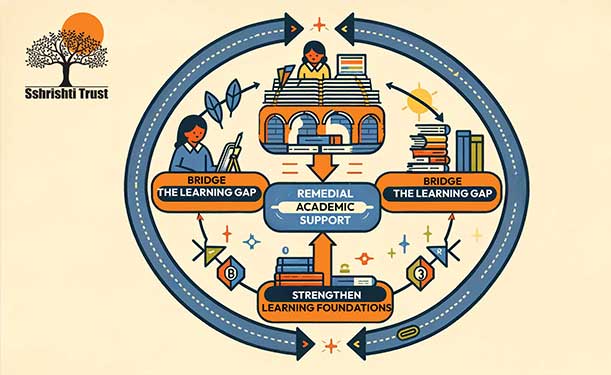
The aim of the both Remedial and Bridge program are same to provide the support students but purpose are different Where Remedial education support to improve a specific weak areas and slow learners. It is an ongoing process until students achieve. In contrast, Bridge education fulfills the education gap and provides foundational learning that is required in the next level. It is a short term program before entering the next level.
In simple terms, remedial programs fix learning problems, while bridge programs prepare students for the next level.
Remedial and bridge education programs are essential for creating an inclusive and effective learning environment. They:
These programs help to prevent long term challenges and specialize for those who have gaps and need extra support. If we do not consider early challenges and the education gap. So it should be difficult to improve their learning journey.
Successful remedial and bridge education programs share several important features:
To make learning effective and enjoyable, these programs use a variety of teaching methods:
These methods help students grasp concepts more easily and build interest in learning.
To make the learning experience engaging and effective, we follow innovative assessment methods, such as debates and interactive Q&A sessions, creating a dynamic and participatory environment that goes beyond traditional teaching methods. Through these initiatives, we aim to not only reinforce academic concepts but also nurture critical thinking skills and a passion for learning among students.
Remedial and bridge programs are designed for:
These programs ensure that every child gets an equal opportunity to learn and succeed.
The success of these programs depends heavily on the involvement of teachers and parents.
Collaboration between teachers and parents leads to better learning outcomes.
Despite their importance, these programs face several challenges:
To overcome these challenges, the following strategies are implemented:
These steps can improve the effectiveness and reach of remedial and bridge education programs.
Remedial education is offered in underserved areas, including slums and rural regions such as Delhi and Uttarakhand.
Remedial and bridge education programs play a vital role in building strong learning and are foundation education in children. It not only helps students overcome academic challenges but also boost their confidence. It helps youth to prepare for future success. By investing in such programs, schools, parents, and policymakers can ensure that every child receives the support they need to thrive in their educational journey.